Wood Mackenzie Releases First Global BESS Integrator Comprehensive Ranking


In the past, competition among energy storage companies mainly focused on battery costs, manufacturing capacity, and supply chain efficiency. However, as large-scale storage projects continue to expand globally, developers, utilities, and investors are increasingly paying attention to whether suppliers have the ability to support the entire project lifecycle, including system integration capabilities, project delivery experience, safety management capabilities, long-term operation and maintenance capabilities, and financial strength.
Against this backdrop, Wood Mackenzie released its first-ever Global Battery Energy Storage System (BESS) Integrator Comprehensive Ranking in 2026, aiming to evaluate the competitiveness of global energy storage system integrators from a more comprehensive perspective.
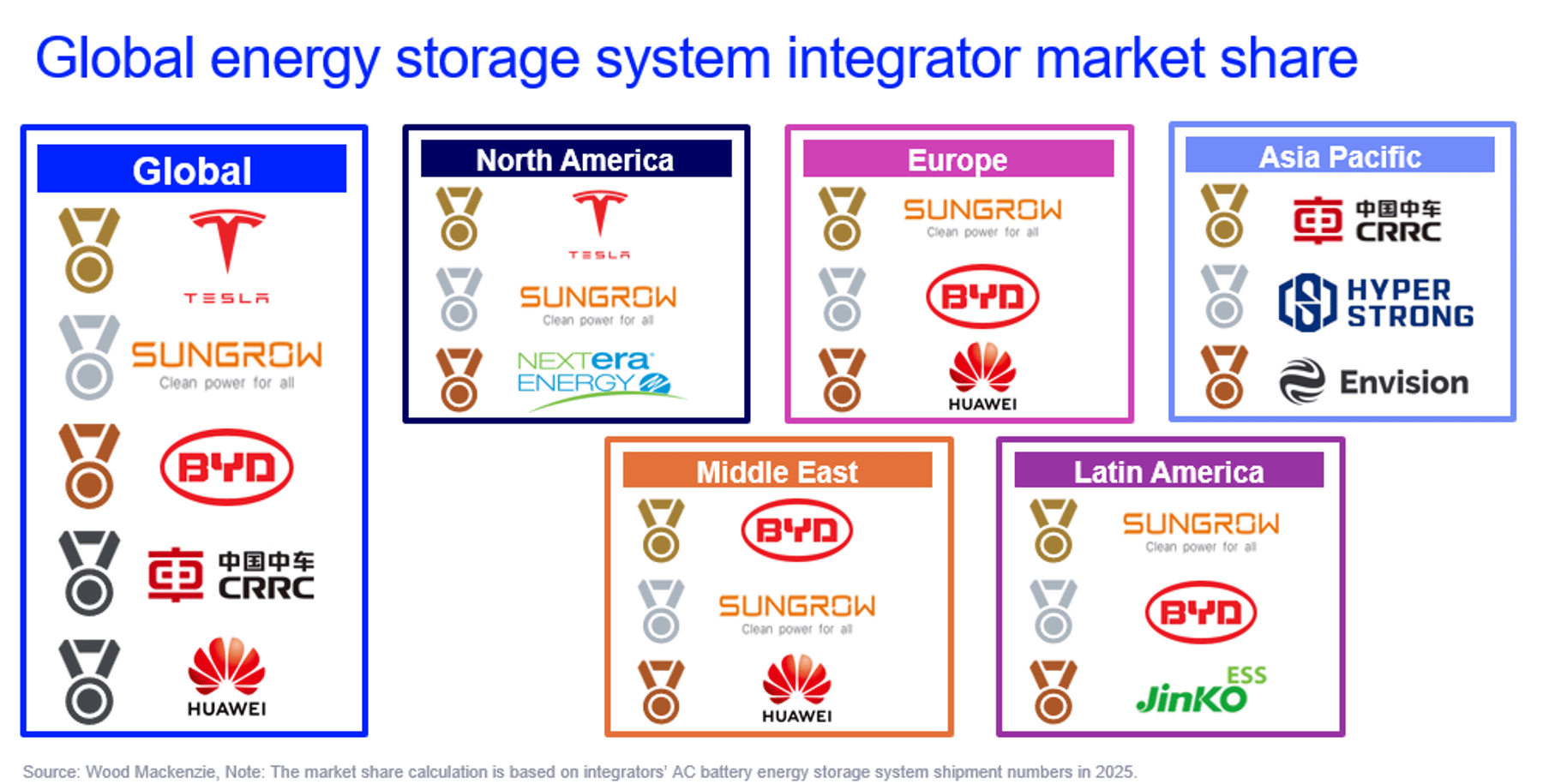
At the same time, another report released by Wood Mackenzie, the 2026 Global BESS Integrator Market Share Ranking, reveals the commercial landscape of the global energy storage market: Chinese system integrators accounted for approximately 76% of the global BESS market share in 2025, maintaining their strong market leadership.
What Are the Differences Between the Two Rankings?
Although both rankings evaluate global BESS system integrators, they focus on completely different dimensions.
The Global BESS Integrator Market Share Ranking mainly answers the question: "Who has deployed the largest amount of energy storage projects?" It focuses on factors such as cumulative deployment capacity, project volume, and regional market share.
The Global BESS Integrator Comprehensive Ranking, however, answers a different question: "Who has the strongest overall capability to deliver and operate large-scale energy storage projects over the long term?" It evaluates companies' capabilities throughout the entire energy storage project lifecycle, including technology maturity, R&D investment, safety performance, supply chain resilience, vertical integration capabilities, ESG performance, and financial strength.
According to Wood Mackenzie's 2026 Global BESS Integrator Market Share Ranking, Chinese energy storage system integrators have further strengthened their position in the global market. In 2025, Chinese companies accounted for approximately 76% of the global BESS system integration market, with eight out of the world’s top ten system integrators headquartered in China. Among them, Tesla and Sungrow maintained their leading global positions for the third consecutive year, while BYD further improved its ranking and entered the global top three.
Unlike the market share ranking, Wood Mackenzie's first-ever Global BESS Integrator Comprehensive Ranking places greater emphasis on companies' long-term competitiveness. The ranking evaluates AC-integrated BESS solutions, which refer to factory-integrated energy storage systems that can be directly connected to the AC grid. These complete solutions include:
• Battery systems;
• Power conversion systems (PCS);
• Battery management systems (BMS);
• Thermal management systems;
• Control systems.
These highly integrated solutions are gaining increasing attention from global utilities, independent power producers, and energy storage project developers because they can reduce system integration risks and improve project delivery certainty.
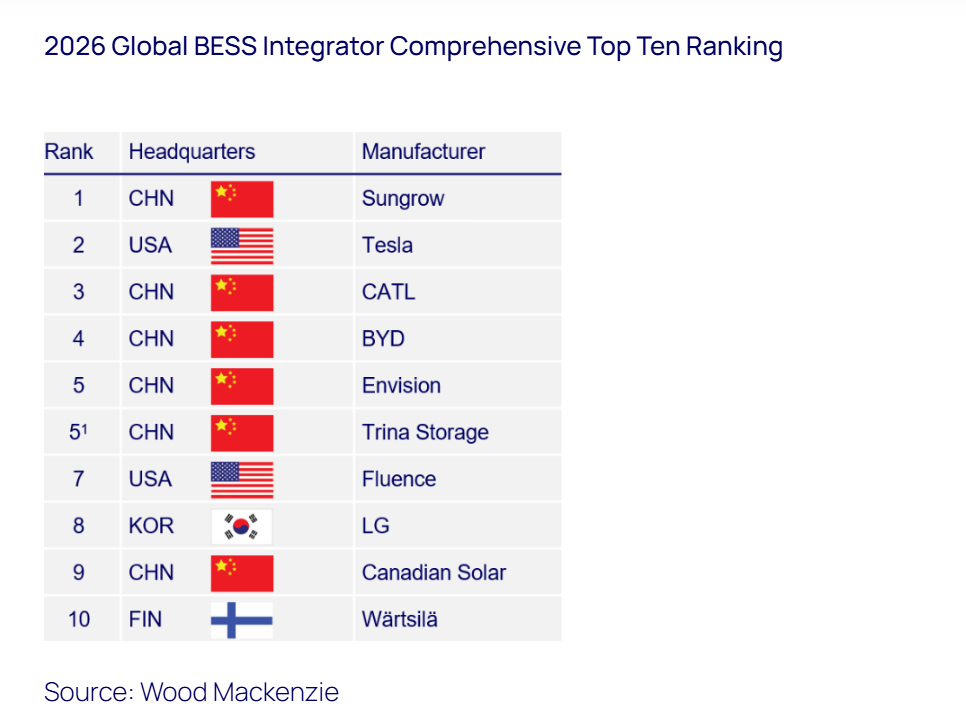
Based on comprehensive evaluations of large-scale project execution experience, system design capabilities, safety management capabilities, global supply chain capabilities, and long-term service capabilities, Wood Mackenzie's 2026 Global BESS Integrator Comprehensive Ranking is as follows:
Sungrow ranked first, followed by Tesla and CATL in second and third place respectively. BYD ranked fourth, while Envision Energy and Trina Storage jointly ranked fifth. Fluence, LG Energy Solution, Canadian Solar, and Wärtsilä also entered the global top ten.
From Manufacturing Advantages to Full Lifecycle Capabilities
Wood Mackenzie pointed out that leading energy storage system integrators are demonstrating several common characteristics.
First, project experience is becoming a core competitive advantage. Among the world’s top ten energy storage integrators, six companies have more than ten years of experience in energy storage system integration. As storage projects become larger and more complex, capabilities in system design, commissioning, safety management, and long-term operation are becoming increasingly important.
Second, vertical integration capabilities are becoming an industry trend. Leading companies in the global ranking generally possess manufacturing capabilities across key components, including battery cells, PCS, or BMS. This vertical integration helps improve product compatibility, strengthen quality control, and reduce uncertainties during the delivery of large-scale energy storage projects.
Meanwhile, the importance of technological innovation and financial stability is also increasing. Energy storage assets typically operate for more than ten years. Therefore, project owners are paying closer attention to whether suppliers can continuously provide warranty services, maintenance support, and technical assistance. Among the top ten companies, eight have exceeded Wood Mackenzie's benchmarks in system efficiency and lifecycle performance, while nine invested more than 4% of their annual revenue into R&D in 2025. In addition, nine companies achieved profitability.
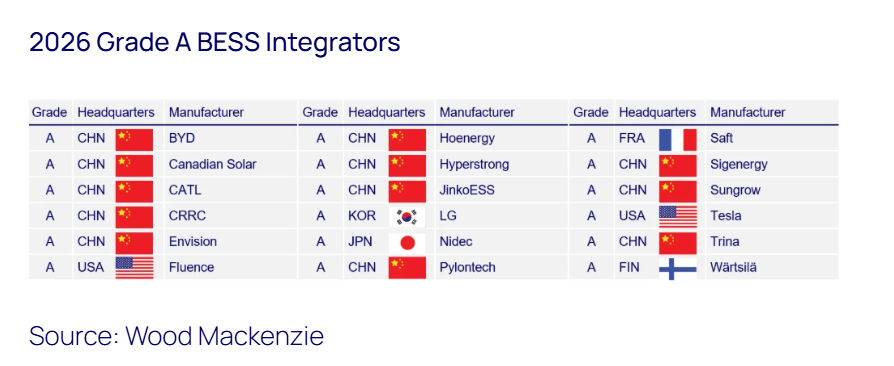
Furthermore, 18 manufacturers received Wood Mackenzie's A-grade certification, reflecting the continued maturity of the global BESS industry and the growing number of suppliers meeting increasingly stringent performance standards.
The Global Market Is Entering a New Competitive Cycle
Together, the two rankings highlight a broader trend: Global energy storage competition is shifting from pure scale competition toward a comprehensive competition based on technology, project execution, capital strength, and long-term operational capabilities.
This transformation also explains why more energy storage companies are expanding beyond equipment manufacturing into project development, investment funds, and asset operations. Energy storage is increasingly becoming similar to traditional energy infrastructure industries.
Featured News
All News →
Italy Opens 16GWh Storage Auction Today as Second MACSE Round Expands by 60%
Italy will open its second MACSE energy storage auction on 24 November, procuring up to 16GWh of capacity from new projects scheduled for delivery in 2029. Compared with the first auction, procurement volume has increased by 60%, while the maximum permitted bid has been reduced from €37,000/MWh/year to €27,000/MWh/year. The results will provide a new indication of competition, regional deployment and current cost levels in Italy's energy storage market.

The Real Test Comes When the Grid Goes Down: 1,000 Witness MWh-Scale Diesel–Battery Microgrid Demonstration
A live MWh-scale demonstration at Sungrow GEPS 2026 showcased how battery storage, diesel generation and grid-forming technology can work together to deliver reliable power in off-grid applications. ENERGY PLANET joined the event to explore the technical highlights and their implications for future C&I energy storage projects.

Tesla Launches 7.4MW Powercore: Connecting Batteries Directly to the 34.5kV Grid and Medium Voltage to 800V Data Centres
Tesla has launched Powercore, a solid-state medium-voltage platform integrating transformer, bidirectional inverter and circuit-breaker functions. Rated at 7.4MW, it connects 800V–2,000V DC systems with 10kV–34.5kV AC networks, targeting battery storage, solar and 800V AI data centres. The first units are scheduled to operate in 2027, although Tesla has not disclosed pricing, customers or initial projects.
UPS Moves to the Grid Edge as Vertiv Launches 3 MVA Medium-Voltage System
Vertiv has launched the 3 MVA PowerNexus MV UPS, moving UPS functionality from the indoor low-voltage side to the outdoor 34.5kV grid connection point. Designed for new and expanding AI data centres, the system integrates fault ride-through, AI load smoothing, power-quality control and one-to-four-hour battery backup. Following a proof-of-concept demonstration in Bologna, commercial shipments are expected to begin in mid-2027.

Envision Gen 8 Selected for 442 MWh Grid Forming BESS in Germany Taking Partnership Close to 600 MWh
Envision Energy and German storage developer ju:niz Energy are advancing the 442 MWh Smareg 13 project in Bavaria. The four-hour, grid-forming development is planned next to the operational Smareg 12 site, while public records currently show a 100 MW/401 MWh configuration and a March 2028 target date.

CATL Delivers First 8-Hour EnerQB Systems for Quinbrook's 24GWh Australian Pipeline
CATL and Quinbrook Infrastructure Partners have completed production and delivery of the first EnerQB long-duration energy storage systems. Designed for eight-hour discharge, the initial units will undergo a 12-month trial at Stanwell Power Station in Queensland, Australia. Quinbrook has identified a potential 3GW/24GWh project pipeline, although wider deployment will depend on trial results, financing, grid connections and subsequent procurement.

1.24GWh! Sungrow Supplies Europe's Largest Operational Energy Storage Project
BW ESS’s Hams Hall project in the UK has officially brought its first phase online, with 350MW/1.243GWh of capacity, making it the largest operational battery storage project in Europe. Sungrow supplied the BESS, with Energy-IO and other partners involved in project delivery. The project also secured a 10-year optimisation agreement with EDF, debt financing from international banks and equity investment from AIP, highlighting the full value chain behind Europe’s GWh-scale storage projects, from equipment supply and project delivery to commercial operations and financing.

BNEF's Q4 Energy Storage Tier 1 List Shrinks 26% to 50 Manufacturers
BloombergNEF has named 50 manufacturers to its Q4 2026 Tier 1 Energy Storage list. Based on publicly available company disclosures, Energy Planet has confirmed 19 of the manufacturers and compiled historical inclusion records for 12 of them. While a single appearance shows that a supplier met the criteria for that quarter, repeat inclusion offers a stronger indication of its ability to maintain a pipeline of qualifying projects. Tier 1 remains a measure of market adoption, however, rather than a product-quality ranking, corporate credit rating or substitute for project-level technical and financial due diligence.