NVIDIA Updates 800VDC White Paper: From Technical Validation to Execution


The rapid expansion of AI data centers is driving computing infrastructure beyond chips, servers, and networks, further into the power system. On August 11, NVIDIA officially released Version 2 of its white paper, "800 VDC Architecture: Industry Alignment & Execution.“
The first edition, released in October 2025, mainly demonstrated the technical necessity and feasibility of adopting 800V high-voltage DC power supply in AI data centers. This update focuses further on system architecture, equipment interfaces, deployment methods, safety protection, validation systems, and industry collaboration.
The white paper clearly states that work related to 800VDC has moved from "concept evaluation" to "coordinated execution." Over the next 12 months, the industry will focus on equipment development, system performance validation, pilot deployment, and standards and regulatory work to accelerate the development of 800VDC solutions that can be deployed in practice.
AI Racks Are Moving Toward Megawatt-Level Power
The growing attention to 800VDC architecture is first related to the rapid increase in AI rack power. As the scale of large language models expands, more and more GPUs need to be connected through NVLink to form large-scale computing domains. To reduce the computing cost and energy consumption of each token, more GPUs need to be deployed within a limited space, driving single-rack power from several hundred kilowatts gradually toward the megawatt level.
According to the rack power roadmap disclosed in the white paper, Gen 1 power racks support up to approximately 145kW; the Gen 2 architecture for Vera Rubin NVL72 increases single-rack power capability to approximately 330kW; and Gen 3 will adopt fully liquid-cooled power modules, busbars, and connectors, with each rack position supporting up to approximately 570kW.
Going further, NVIDIA plans to transition to a native 800VDC rack architecture in Gen 4, providing a more scalable power supply approach for computing racks approaching the megawatt level.
At present, NVIDIA's existing and near-term computing systems will still convert 800VDC to 54VDC inside the rack to remain compatible with mature power architectures. However, as rack power continues to increase, the current required for low-voltage power delivery, as well as copper, connectors, and thermal management space, will all increase significantly.
Compared with 54VDC, 800VDC can reduce current when delivering the same amount of power, reduce the space occupied by the power supply system, and eliminate some power conversion stages. Therefore, NVIDIA regards it as an important technology route for the continued expansion of next-generation high-density AI racks.
800VDC Will Not Immediately Replace Existing AC Systems
The white paper also emphasizes that 800VDC is not intended to immediately replace existing 415V or 480V AC power supply systems, but rather to serve as an additional deployment option that will coexist with AC architectures over the long term.
Currently, a large number of existing and under-construction data centers still use mature AC distribution systems. If 800VDC can only be applied to newly built data centers, the speed of technology adoption will be limited, and it could also result in wasted investments in existing land, power connections, and distribution equipment.
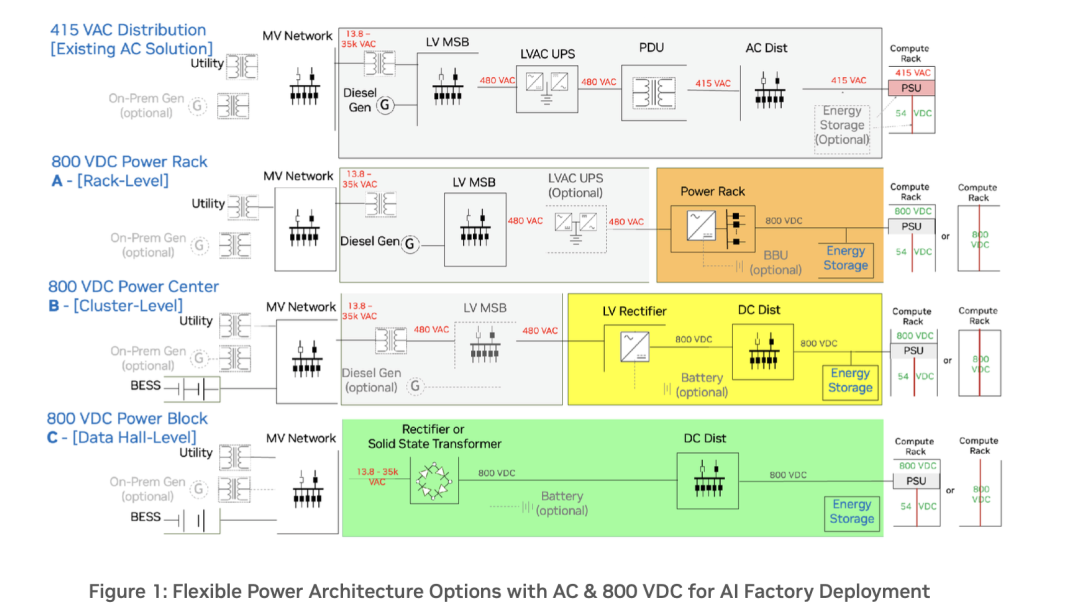
Therefore, NVIDIA proposes several optional deployment approaches in the white paper. Operators can choose to introduce 800VDC at the rack level, cluster level, or data hall level according to existing facility conditions, construction schedules, computing density, and investment plans, without having to upgrade the system step by step in a fixed sequence.
Three 800VDC Deployment Architectures
▍Option A: Rack-Level Power Rack
Option A involves configuring a dedicated Power Rack next to the computing racks. The existing data center continues to receive power through a 415V to 480V AC system, while the Power Rack performs AC-to-800VDC conversion near the racks and supplies power to adjacent computing racks through standardized DC interfaces.
The initial Power Rack has a capacity of approximately 660kW and can supply power to one or two computing racks. This approach can make use of existing AC infrastructure without requiring large-scale modifications to the upstream electrical room, making it suitable for early deployment of 800VDC computing equipment in existing data centers, test facilities, and laboratories.
According to the timeline disclosed in the white paper, the Power Rack is planned to enter production in the third quarter of 2026, making it the 800VDC solution currently closest to practical deployment.
However, the Power Rack requires additional data center space and also needs to accommodate a relatively large number of AC input cables. As computing scale expands, the number of power racks and their space requirements may become limiting factors for further expansion.
▍Option B: Cluster-Level Power Center
Option B concentrates rectification equipment at the end of a row of racks or a computing cluster, forming a unified DC Power Center. Each Power Center can provide up to approximately 2MW of output capacity, which is then distributed to multiple computing racks through 800VDC overhead busbars, tap boxes, or remote distribution panels.
Compared with the rack-level Power Rack, this solution reduces the number of power supply devices and power cables located next to computing racks. It can also selectively provide 800VDC to high-density computing clusters without changing the upstream AC distribution room.
According to the white paper, Option B is expected to be deployed as early as the third quarter of 2027. At present, multiple equipment manufacturers are developing and certifying 800VDC rectifiers, DC busbars, tap boxes, connectors, and protection devices.
▍Option C: Data Hall-Level DC Power Block
Option C is designed for future ultra-high-density AI factories, further concentrating power conversion and distribution at the data hall level. This architecture uses an approximately 4.8MW DC Power Block as a standardized power unit, supplying 800VDC power to the entire data hall through high-capacity DC switchgear and busbars. Four scalable units can form an approximately 20MW standardized deployment unit, which can then be replicated across a campus to support AI factories ranging from hundreds of megawatts to gigawatt scale.
The DC Power Block can also adopt a modular and outdoor containerized design, allowing it to be assembled and tested at the factory before being transported to the project site, thereby reducing on-site construction work, equipment room footprint, and commissioning complexity. In the longer-term architecture, NVIDIA hopes to directly convert the 34.5kV medium-voltage AC commonly used in data center power distribution into 800VDC, further reducing intermediate low-voltage conversion stages. In the future, a single power block may scale to 10MW or more, while the next-generation solid-state transformer technology roadmap points toward around 2029.
However, the white paper also points out that most commercially available solid-state transformers currently mainly target approximately 15kV inputs. To adapt to 34.5kV data center distribution systems, issues including insulation coordination, fault protection, thermal management, and grid connection still need to be addressed. Therefore, this part remains a medium- to long-term development direction.
Energy Storage Enters Different Layers of AI Data Centers
In this white paper, energy storage not only serves the traditional backup power function, but is also incorporated into rack-level load management, data center power regulation, and DC microgrid architectures.
▍First is short-duration energy storage at the rack level
AI computing loads are characterized by rapid changes and a high degree of synchronization. When large numbers of GPUs start simultaneously or adjust computing tasks, rack power may change significantly over a short period of time. The white paper proposes that small-capacity, fast-response energy storage devices, such as electrolytic capacitors, can be deployed inside or near computing racks to reduce instantaneous power peaks, smooth loads, and control the rate of power changes.
In the initial Vera Rubin Power Rack design, each power module is also equipped with 1,200J of energy storage to improve the AC input current under dynamic loads. The Power Rack can also optionally be equipped with a BBU consisting of four 20kW modules, providing a total of 80kW of power for approximately 60 seconds to provide short-duration power support for the rack.
▍Second is large-scale battery energy storage systems at the data center level
In the data hall-level DC Power Block architecture, energy storage, DC UPS systems, renewable energy, and behind-the-meter generation facilities can be integrated with the 800VDC system to further form a DC microgrid. Since batteries themselves output DC power, directly connecting them to the DC bus has the potential to reduce repeated AC-DC conversion and synchronization stages. In the future, large-scale BESS can undertake load smoothing, grid interconnection support, on-site generation coordination, and enhanced power resilience.
However, the white paper does not disclose the specific capacity, storage duration, battery technology route, or suppliers for large-scale energy storage, nor does it announce any specific energy storage procurement plans. What can currently be confirmed is that energy storage has been incorporated into NVIDIA's future AI factory power architecture, while the configuration of specific projects will still need to be further determined according to data center and grid conditions.
Safety Protection and Certification Remain Key to Deployment
Compared with mature AC systems, 800VDC has different technical requirements for fault protection. AC current has periodic zero-crossing points, making arc interruption relatively easier; DC current has no natural zero-crossing point, meaning that arcs may persist. Therefore, 800VDC systems need to place greater emphasis on fault current limitation, DC arc detection, grounding methods, insulation monitoring, connector interlocking, and rapid fault isolation.
The white paper lists several grounding options, including high-resistance midpoint grounding, high-resistance circuit grounding, floating grounding, and direct grounding. However, no single grounding method has yet been determined, and system-level evaluation is still required based on personnel safety, fault detection, equipment supply, and operational continuity.
In terms of protection equipment, molded-case circuit breakers with more mature supply chains and certification systems may be adopted first in the short term. In the long term, solid-state circuit breakers can interrupt faults at the sub-millisecond level, reducing peak fault current and arc energy, and are therefore regarded as important protection devices for high-density 800VDC systems.
NVIDIA is currently focusing on two types of products: 125A air-cooled solid-state circuit breakers and 1,250A solid-state circuit breakers, targeting rack-level internal power modules and future native 800VDC rack interfaces, respectively.
At the same time, NVIDIA is working with cloud service providers, equipment companies, and organizations such as UL Solutions to advance requirements for power quality, dynamic response, grounding protection, equipment certification, and system stability, while coordinating with standards systems including UL, NFPA, IEEE, and IEC.
From Architectural Consensus to Industry Execution
Compared with the first edition of the white paper, the most important change in this update is that the focus of the 800VDC discussion has shifted from "why it is needed” to “how to deploy it."
At present, the relevant architectures are gradually converging toward several major forms at the rack, cluster, and data hall levels, allowing equipment companies to develop products around relatively standardized power levels, connection interfaces, busbar systems, and protection requirements.
Over the next 12 months, the industry will continue to establish system-level performance requirements and validate the system from medium-voltage AC input all the way to the GPU chip side. Through hardware testing, system integration, and digital simulation, the industry will evaluate the compatibility, stability, and reliability of equipment from different manufacturers. At the same time, pilot deployment, equipment certification, installation and commissioning, and operation and maintenance standards will also be advanced simultaneously.
It should be noted that some of the timelines and products mentioned in the white paper are still part of the roadmap and do not mean that commercial deployment has already been completed. However, from the overall direction, 800VDC is no longer merely a conceptual architecture for AI data centers, but is beginning to enter the stages of equipment development, system validation, and industry collaboration.
As AI racks move toward higher power density, the data center power system will gradually shift from a traditional supporting facility to a core infrastructure component that affects computing scale, construction speed, and operational efficiency. The changes brought by 800VDC will also extend to multiple areas, including rectifiers, DC busbars, connectors, circuit breakers, solid-state transformers, energy storage, and energy management systems.
Future AI data centers will need not only larger battery capacity, but also faster power response, DC-side integration capabilities, fault current control, and the ability to operate in coordination with computing loads and on-site power sources. From this perspective, NVIDIA's latest white paper is not only an update on 800V power supply technology, but also an execution roadmap for the power infrastructure of next-generation AI factories.
Featured News
All News →
Italy Opens 16GWh Storage Auction Today as Second MACSE Round Expands by 60%
Italy will open its second MACSE energy storage auction on 24 November, procuring up to 16GWh of capacity from new projects scheduled for delivery in 2029. Compared with the first auction, procurement volume has increased by 60%, while the maximum permitted bid has been reduced from €37,000/MWh/year to €27,000/MWh/year. The results will provide a new indication of competition, regional deployment and current cost levels in Italy's energy storage market.

The Real Test Comes When the Grid Goes Down: 1,000 Witness MWh-Scale Diesel–Battery Microgrid Demonstration
A live MWh-scale demonstration at Sungrow GEPS 2026 showcased how battery storage, diesel generation and grid-forming technology can work together to deliver reliable power in off-grid applications. ENERGY PLANET joined the event to explore the technical highlights and their implications for future C&I energy storage projects.

Tesla Launches 7.4MW Powercore: Connecting Batteries Directly to the 34.5kV Grid and Medium Voltage to 800V Data Centres
Tesla has launched Powercore, a solid-state medium-voltage platform integrating transformer, bidirectional inverter and circuit-breaker functions. Rated at 7.4MW, it connects 800V–2,000V DC systems with 10kV–34.5kV AC networks, targeting battery storage, solar and 800V AI data centres. The first units are scheduled to operate in 2027, although Tesla has not disclosed pricing, customers or initial projects.
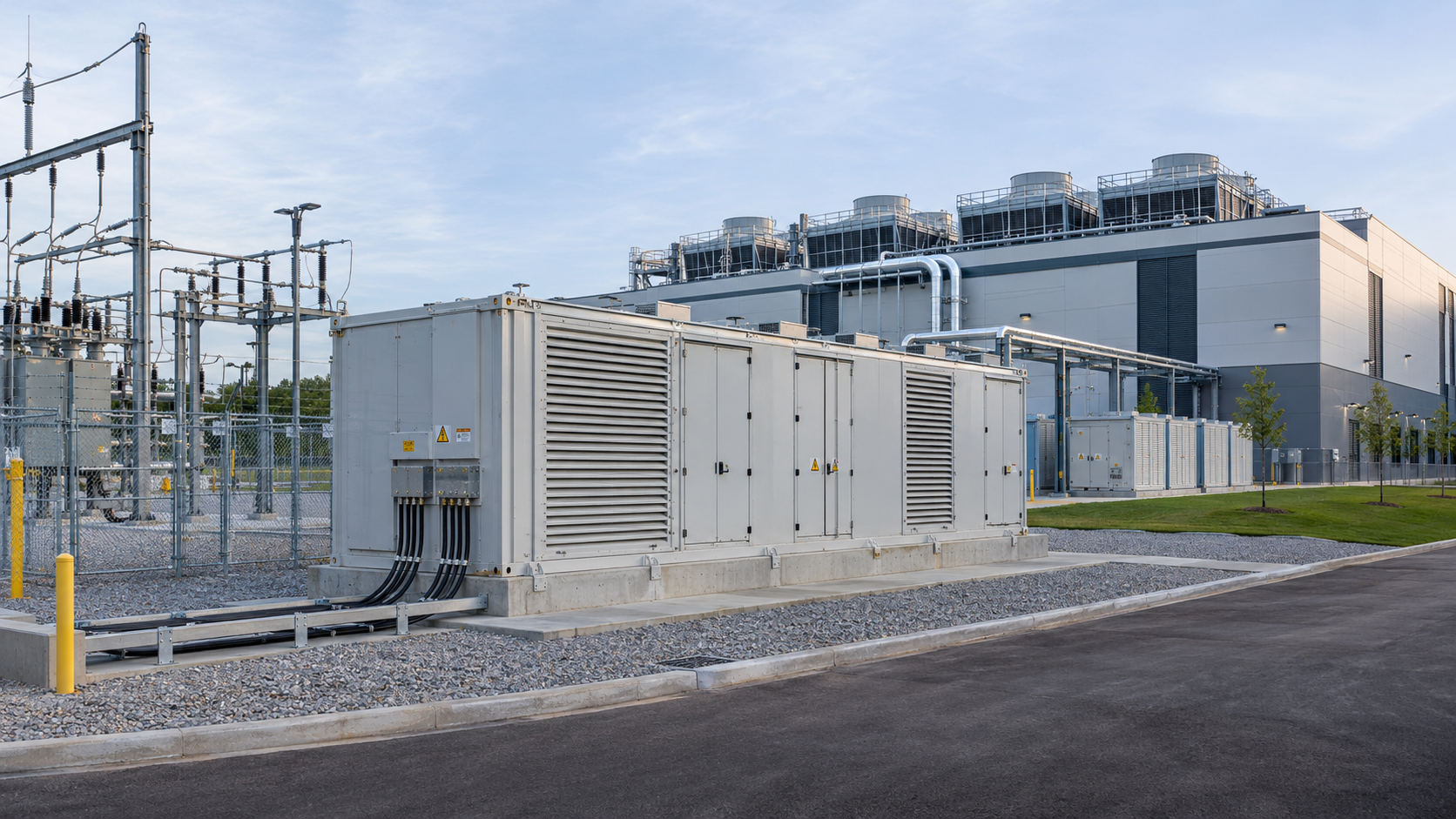
UPS Moves to the Grid Edge as Vertiv Launches 3 MVA Medium-Voltage System
Vertiv has launched the 3 MVA PowerNexus MV UPS, moving UPS functionality from the indoor low-voltage side to the outdoor 34.5kV grid connection point. Designed for new and expanding AI data centres, the system integrates fault ride-through, AI load smoothing, power-quality control and one-to-four-hour battery backup. Following a proof-of-concept demonstration in Bologna, commercial shipments are expected to begin in mid-2027.

Envision Gen 8 Selected for 442 MWh Grid Forming BESS in Germany Taking Partnership Close to 600 MWh
Envision Energy and German storage developer ju:niz Energy are advancing the 442 MWh Smareg 13 project in Bavaria. The four-hour, grid-forming development is planned next to the operational Smareg 12 site, while public records currently show a 100 MW/401 MWh configuration and a March 2028 target date.

CATL Delivers First 8-Hour EnerQB Systems for Quinbrook's 24GWh Australian Pipeline
CATL and Quinbrook Infrastructure Partners have completed production and delivery of the first EnerQB long-duration energy storage systems. Designed for eight-hour discharge, the initial units will undergo a 12-month trial at Stanwell Power Station in Queensland, Australia. Quinbrook has identified a potential 3GW/24GWh project pipeline, although wider deployment will depend on trial results, financing, grid connections and subsequent procurement.

1.24GWh! Sungrow Supplies Europe's Largest Operational Energy Storage Project
BW ESS’s Hams Hall project in the UK has officially brought its first phase online, with 350MW/1.243GWh of capacity, making it the largest operational battery storage project in Europe. Sungrow supplied the BESS, with Energy-IO and other partners involved in project delivery. The project also secured a 10-year optimisation agreement with EDF, debt financing from international banks and equity investment from AIP, highlighting the full value chain behind Europe’s GWh-scale storage projects, from equipment supply and project delivery to commercial operations and financing.

BNEF's Q4 Energy Storage Tier 1 List Shrinks 26% to 50 Manufacturers
BloombergNEF has named 50 manufacturers to its Q4 2026 Tier 1 Energy Storage list. Based on publicly available company disclosures, Energy Planet has confirmed 19 of the manufacturers and compiled historical inclusion records for 12 of them. While a single appearance shows that a supplier met the criteria for that quarter, repeat inclusion offers a stronger indication of its ability to maintain a pipeline of qualifying projects. Tier 1 remains a measure of market adoption, however, rather than a product-quality ranking, corporate credit rating or substitute for project-level technical and financial due diligence.