Beyond the Rankings: What HTW Berlin and aquu's Energy Storage Inspection 2026 Test Really Shows


HTW Berlin and aquu's Energy Storage Inspection 2026 tested 12 residential PV-battery systems involving 10 manufacturers. Eight manufacturers participated publicly under their brand names, while two additional DC-coupled systems were independently purchased by the testing team and presented anonymously. Beyond comparing overall system efficiency, the report also breaks down usable capacity, conversion efficiency, battery efficiency, dynamic control, standby consumption, and other key aspects.
Looking at the final results, SAX Power ranked first in the 5 kW class, while FOX ESS set a new record for the 10 kW reference case with an SPI of 97.0%. However, the real value of the report goes beyond simply producing a ranking. It raises a more important question: Why do residential storage systems with seemingly similar specifications still show meaningful differences in real operating performance? To answer that question, we first need to start with the ranking itself.
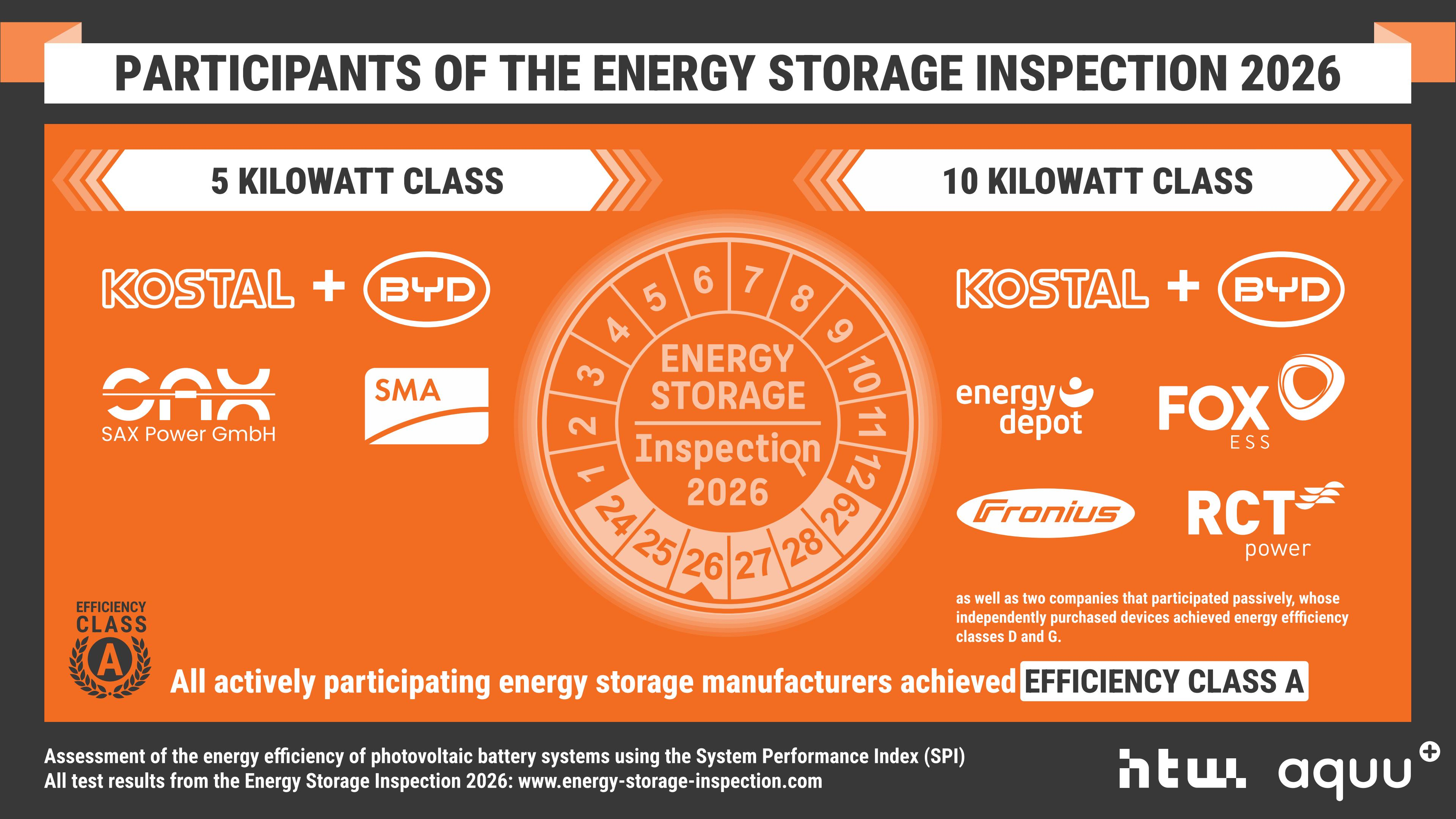
5 kW and 10 kW: Who Leads in 2026?
HTW evaluates systems using two different reference cases: SPI (5 kW) and SPI (10 kW). The 5 kW class represents a smaller residential PV and household-load configuration, while the 10 kW class reflects a larger PV system with additional loads such as a heat pump and an electric vehicle. Therefore, the two SPI values should not be compared directly; the meaningful comparison is within each class.
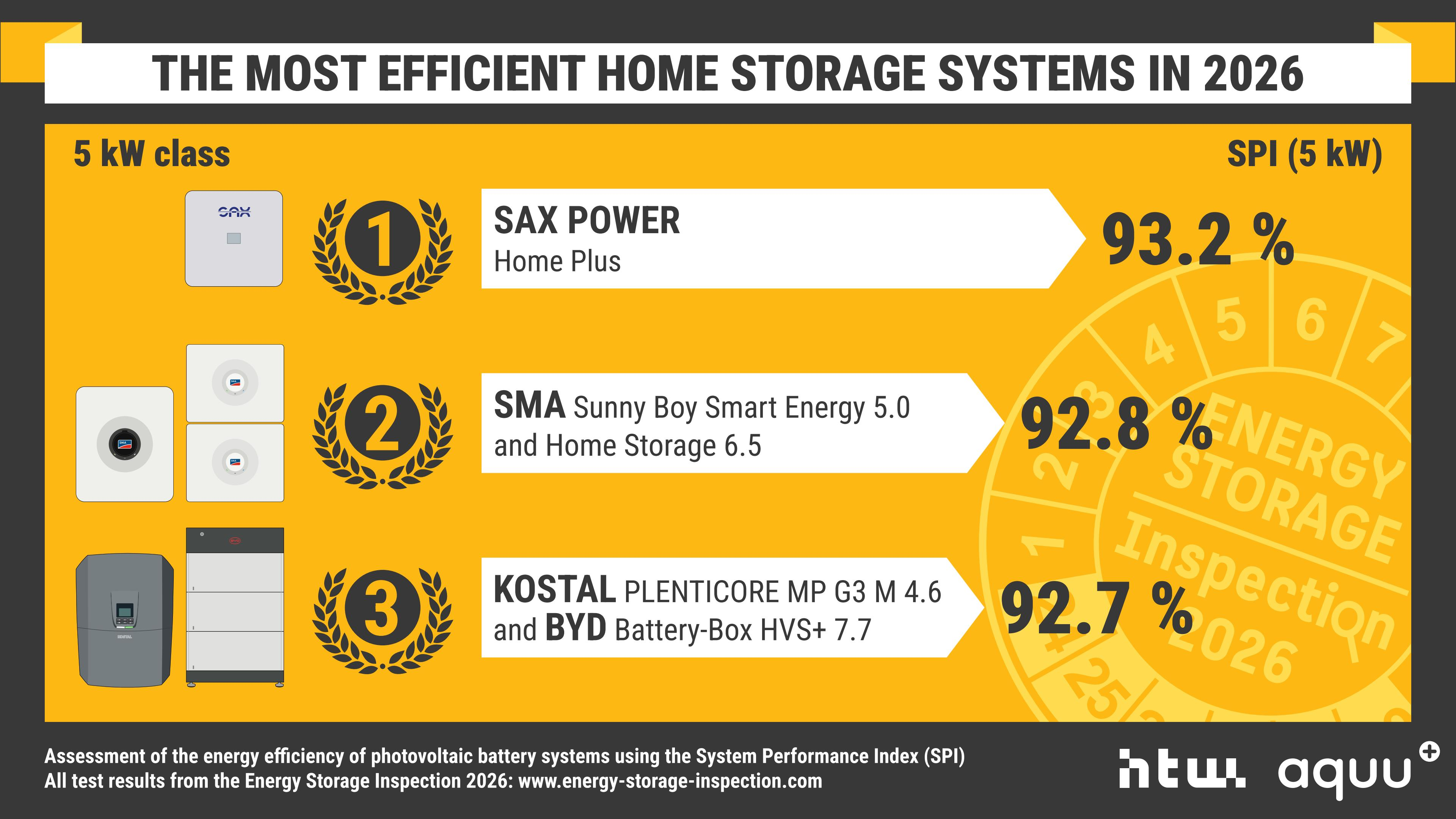
In the 5 kW class, SAX Power Home Plus ranked first with an SPI of 93.2%. SMA Sunny Boy Smart Energy 5.0 paired with Home Storage 6.5 followed closely at 92.8%, while the DC-coupled KOSTAL PLENTICORE MP G3 M 4.6 paired with BYD Battery-Box HVS+ 7.7 ranked third at 92.7%. Only 0.5 percentage points separated the top three systems, showing that the leading products in this class are already performing at a very similar overall level.
The gap was more pronounced in the 10 kW class. FOX ESS PQ-H3-Ultra-10.0 paired with EQ3300-5 ranked first with an SPI of 97.0%, which the report identifies as a new record for this reference case. RCT Power ranked second at 96.4%, while Energy Depot, Fronius, and the DC-coupled KOSTAL + BYD system all remained above 95%. By comparison, the two anonymously purchased systems achieved only 91.9% and 89.3%, corresponding to Efficiency Classes D and G.
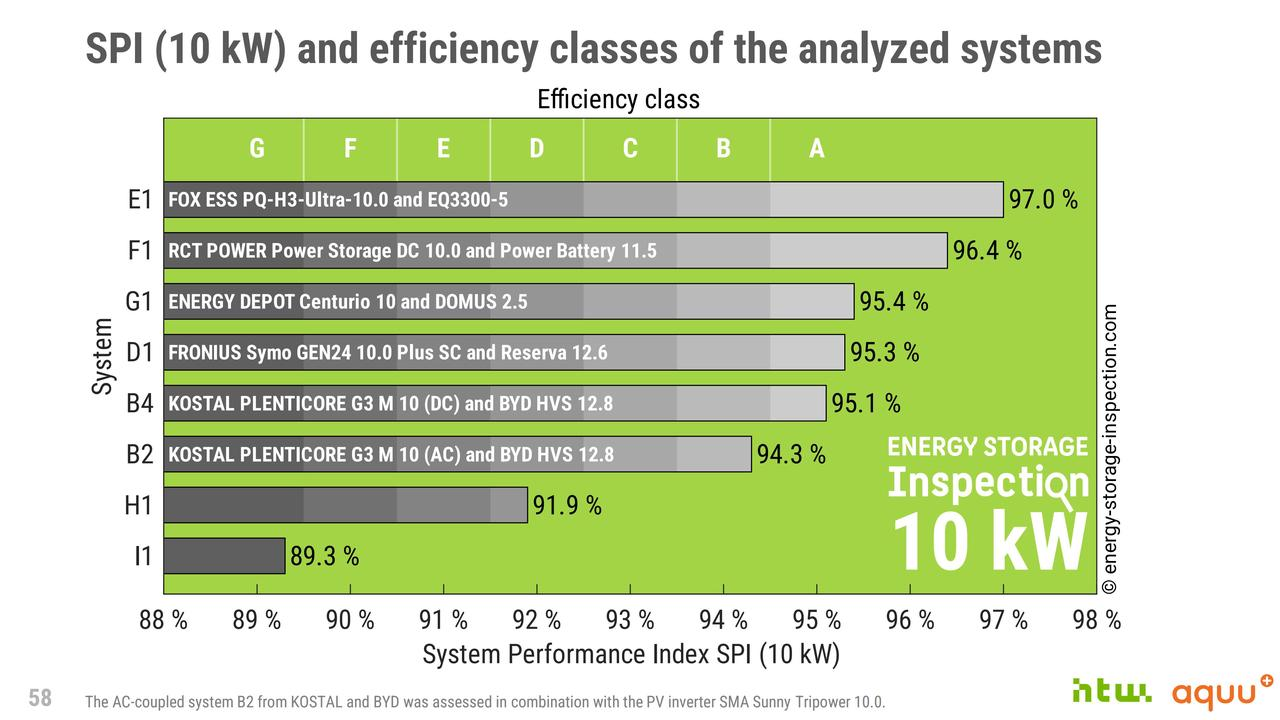
Overall, 10 of the 12 tested systems achieved Efficiency Class A or B, indicating that mainstream residential storage systems have already reached a relatively high level of overall efficiency. But this also raises another question: If most systems are already "highly efficient," why can SPI still range from 97.0% down to 89.3%? The answer lies in the different types of losses within the system.
Where Do the Differences Between Leading Systems Come From?
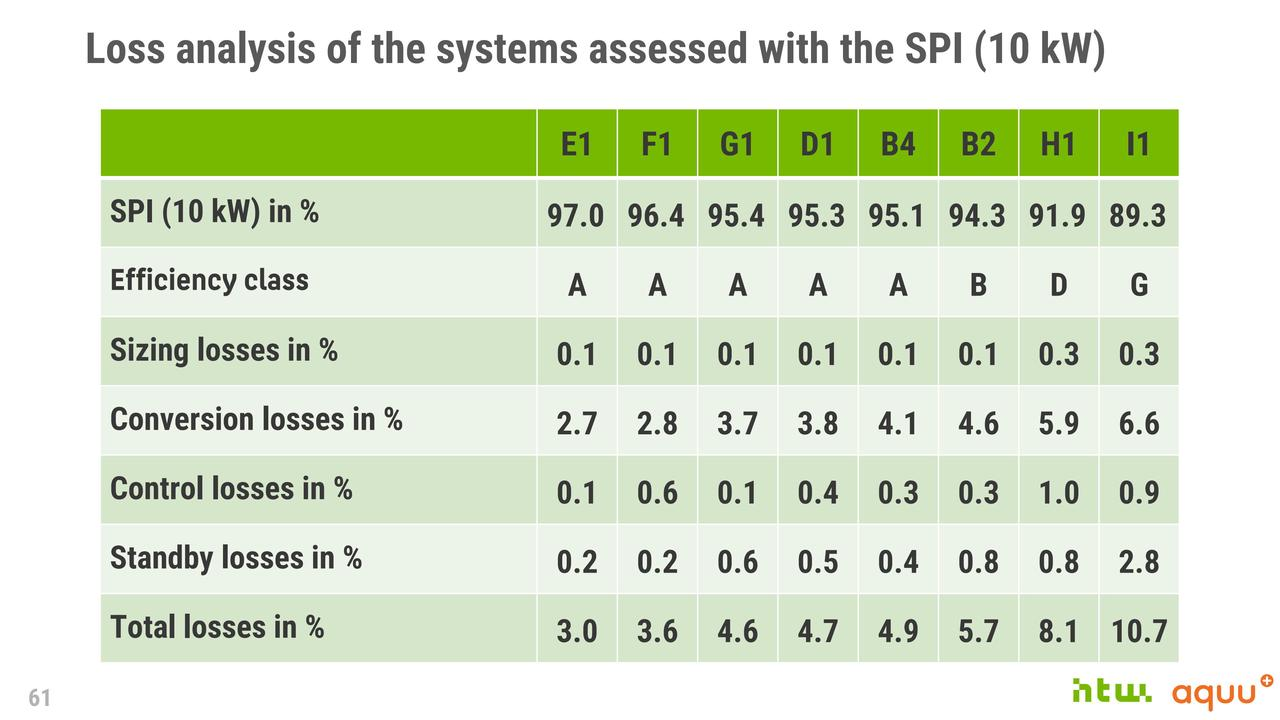
The value of SPI is that it does not focus on a single peak conversion-efficiency figure. Instead, it incorporates multiple sources of system loss. HTW divides these into Sizing losses, Conversion losses, Control losses, and Standby losses, making it possible to see more clearly where energy is actually being lost.
In the 10 kW class, FOX ESS had total losses of just 3.0%, while the weakest anonymous system reached 10.7%. For most products, conversion losses remained the largest contributor, but they were not the only factor. How accurately and quickly the control system follows changing loads, as well as how much energy the system consumes at low power or in standby mode, also accumulates into the final SPI result.
This explains why looking only at inverter efficiency or battery capacity can easily lead to an incomplete conclusion. Even if a product has very high conversion efficiency under ideal conditions, its annual performance in a real home can still be dragged down if efficiency falls sharply at low load or if additional losses continue to accumulate during control and standby operation.
That leads to another test in the report that deserves closer attention: partial-load efficiency.
Why Partial-Load Efficiency Matters
Residential storage systems do not operate continuously at 5 kW or 10 kW. In reality, refrigerators, lighting, standby appliances, and basic household loads often add up to only a few hundred watts. As a result, efficiency in the low-power range may be more representative of what users actually experience day to day than peak efficiency.
The report shows that at 200 W discharge, the highest tested efficiency reached 92.1%, while the less-efficient reference inverter achieved only 70.7%. At 100 W, the gap widened further: RCT Power reached 86.1%, while the lowest reference system dropped to just 53.9%.
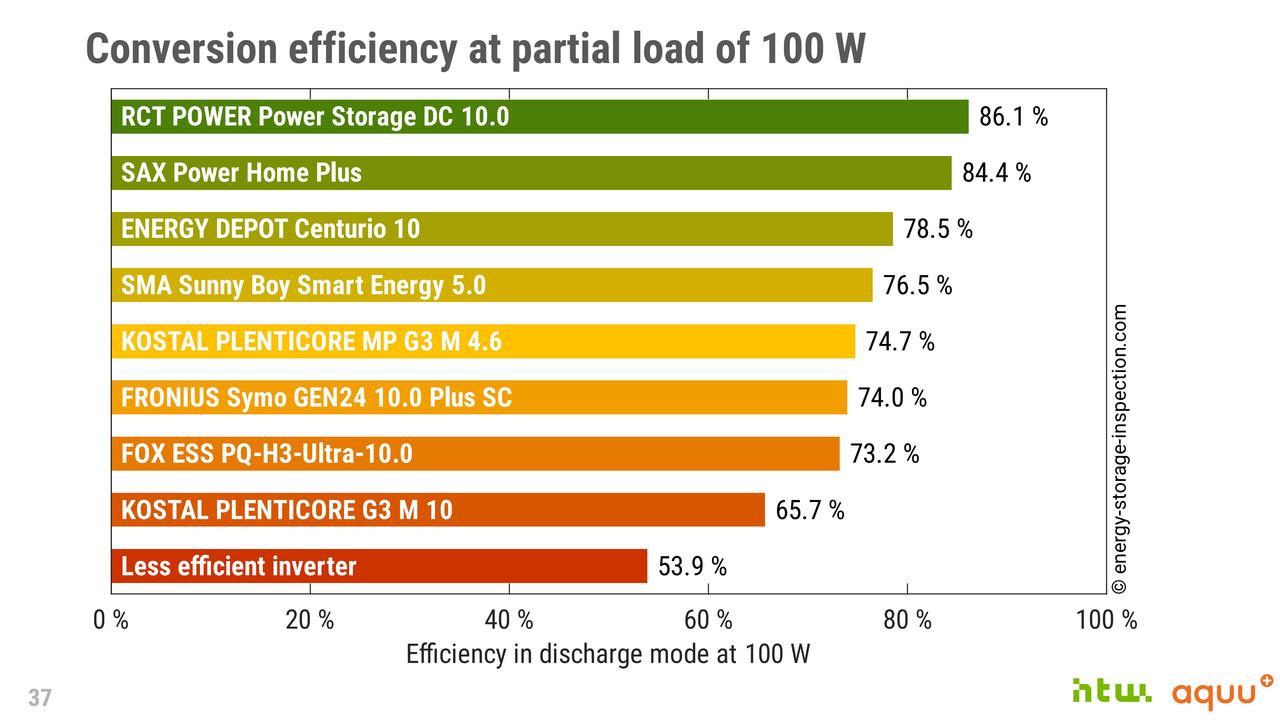
This result matters because it shows that while leading systems may perform very similarly at rated or higher power levels, the gap can widen again quickly once they move into the low-load range that is more common in residential use. For home-storage users, the more useful question in the future may no longer be simply "What is the maximum efficiency?" but rather "How efficient is the system at the power levels my home actually uses most of the time?"
However, partial-load efficiency only explains how much energy is lost. It does not yet answer another key question: Can the system respond quickly enough when household demand keeps changing?
Response Speed and Standby Performance Also Start to Matter
Residential loads are not static. Heat pumps switch on, EV charging changes, and even ordinary household appliances continuously alter the power demand. A storage system therefore needs not only to be efficient, but also to adjust its output quickly enough.
In the dynamic control tests, Energy Depot and RCT Power both recorded a settling time of just 0.2 seconds, the fastest result in the report. The two anonymous systems, by contrast, required 13.7 seconds and 10.9 seconds respectively.
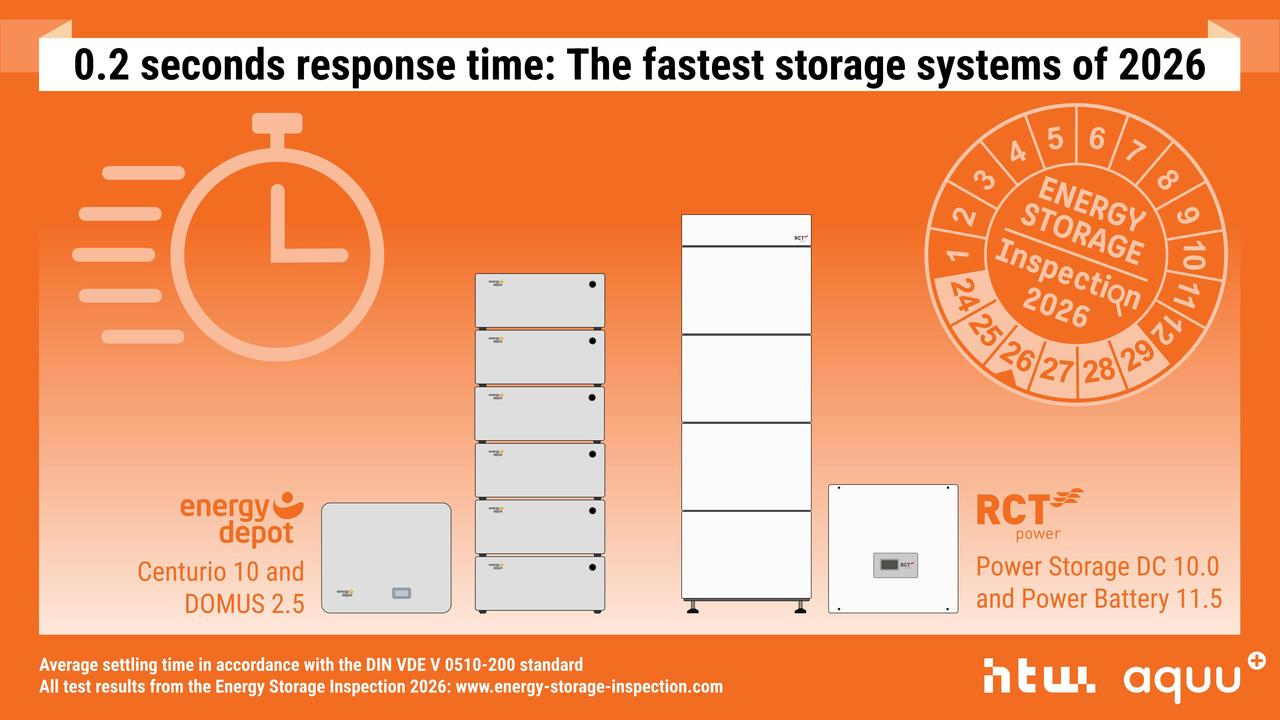
This difference means that when household demand changes suddenly, a faster system can adjust battery power more quickly, while a slower system may temporarily import additional electricity from the grid or feed more power into it. In other words, system performance depends not only on how much energy is lost during each conversion, but also on whether the system can respond correctly at the right time.
The same logic applies to standby consumption. The report shows that some high-performing systems can keep standby power consumption to only a few watts, while certain systems consume noticeably more when the battery is discharged. These losses may not appear significant in a single moment, but for a residential storage system that spends many hours each year at low load or in standby mode, they eventually accumulate into real operating costs.
By this point, the report has moved from "Who ranks first?" to "Why do different systems behave differently in real operation?" But for users, there is still one more practical question: What are these efficiency differences actually worth?
Dynamic Tariffs Make Efficiency More Important
The second half of the report goes on to examine grid charging under dynamic electricity tariffs. The basic logic is straightforward: charge the battery from the grid when electricity prices are low, then use the stored energy to supply the home when prices are higher, reducing electricity costs through the price spread.
But this model only works under one condition: the price spread must be large enough to cover the system losses generated during charging, storage, and discharging.
HTW provides a clear example. In a more efficient system, grid electricity can achieve an overall efficiency of 78% after going through the complete charge-storage-discharge process, while a less-efficient system reaches only 63%. If the system is also operating at low power, the decline in partial-load efficiency can further reduce the economic benefit.
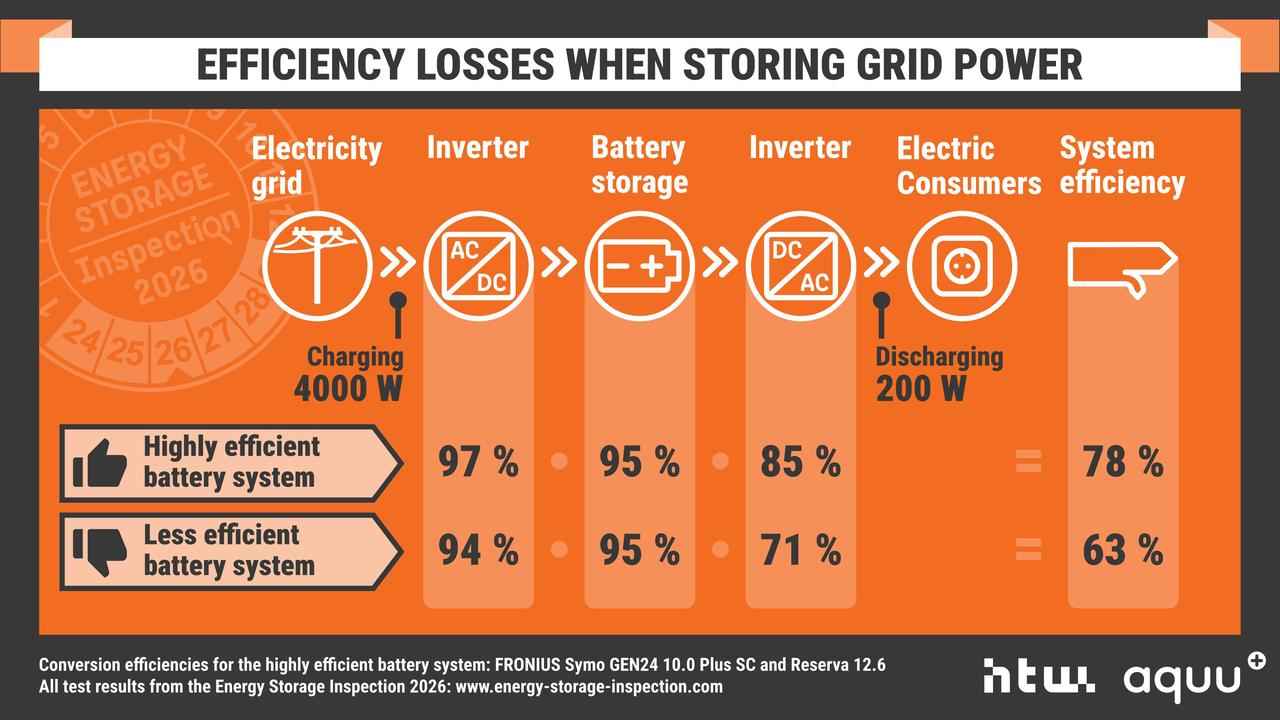
As dynamic tariffs, smart meters, and intelligent EMS become more common across Europe, efficiency is no longer just a laboratory performance metric. It is increasingly likely to determine how much real value a storage system can capture from electricity-market price fluctuations.
This also suggests that the competitive logic of residential storage may change. Simply increasing battery capacity will not guarantee better economics. The system must also be able to charge and discharge with lower losses, while responding quickly to household demand and electricity-price signals.
What Do the 2026 Test Results Tell Us?
On the surface, Energy Storage Inspection 2026 is an efficiency ranking. But the logic connecting the report is actually quite clear: the ranking is the outcome, system losses explain the outcome, partial-load and dynamic-control tests reveal the differences in real-world operation, and dynamic electricity pricing ultimately turns those technical differences into economic differences.
SAX Power and FOX ESS took first place in the 5 kW and 10 kW classes respectively. But as peak efficiency among mainstream products continues to converge, the factors that may increasingly differentiate products are partial-load efficiency, control response, standby consumption, and how well the entire system performs together under real residential conditions.
For consumers, installers, and distributors, this means that comparing residential storage systems may increasingly require moving beyond a single nominal capacity or maximum-efficiency figure toward a broader question: How much of the energy handled by this system can actually be turned into real value under real household conditions and real electricity prices?
Source: HTW Berlin & aquu, Energy Storage Inspection 2026, Version 1.0, March 2026.
Featured News
All News →
Italy Opens 16GWh Storage Auction Today as Second MACSE Round Expands by 60%
Italy will open its second MACSE energy storage auction on 24 November, procuring up to 16GWh of capacity from new projects scheduled for delivery in 2029. Compared with the first auction, procurement volume has increased by 60%, while the maximum permitted bid has been reduced from €37,000/MWh/year to €27,000/MWh/year. The results will provide a new indication of competition, regional deployment and current cost levels in Italy's energy storage market.

The Real Test Comes When the Grid Goes Down: 1,000 Witness MWh-Scale Diesel–Battery Microgrid Demonstration
A live MWh-scale demonstration at Sungrow GEPS 2026 showcased how battery storage, diesel generation and grid-forming technology can work together to deliver reliable power in off-grid applications. ENERGY PLANET joined the event to explore the technical highlights and their implications for future C&I energy storage projects.

Tesla Launches 7.4MW Powercore: Connecting Batteries Directly to the 34.5kV Grid and Medium Voltage to 800V Data Centres
Tesla has launched Powercore, a solid-state medium-voltage platform integrating transformer, bidirectional inverter and circuit-breaker functions. Rated at 7.4MW, it connects 800V–2,000V DC systems with 10kV–34.5kV AC networks, targeting battery storage, solar and 800V AI data centres. The first units are scheduled to operate in 2027, although Tesla has not disclosed pricing, customers or initial projects.
UPS Moves to the Grid Edge as Vertiv Launches 3 MVA Medium-Voltage System
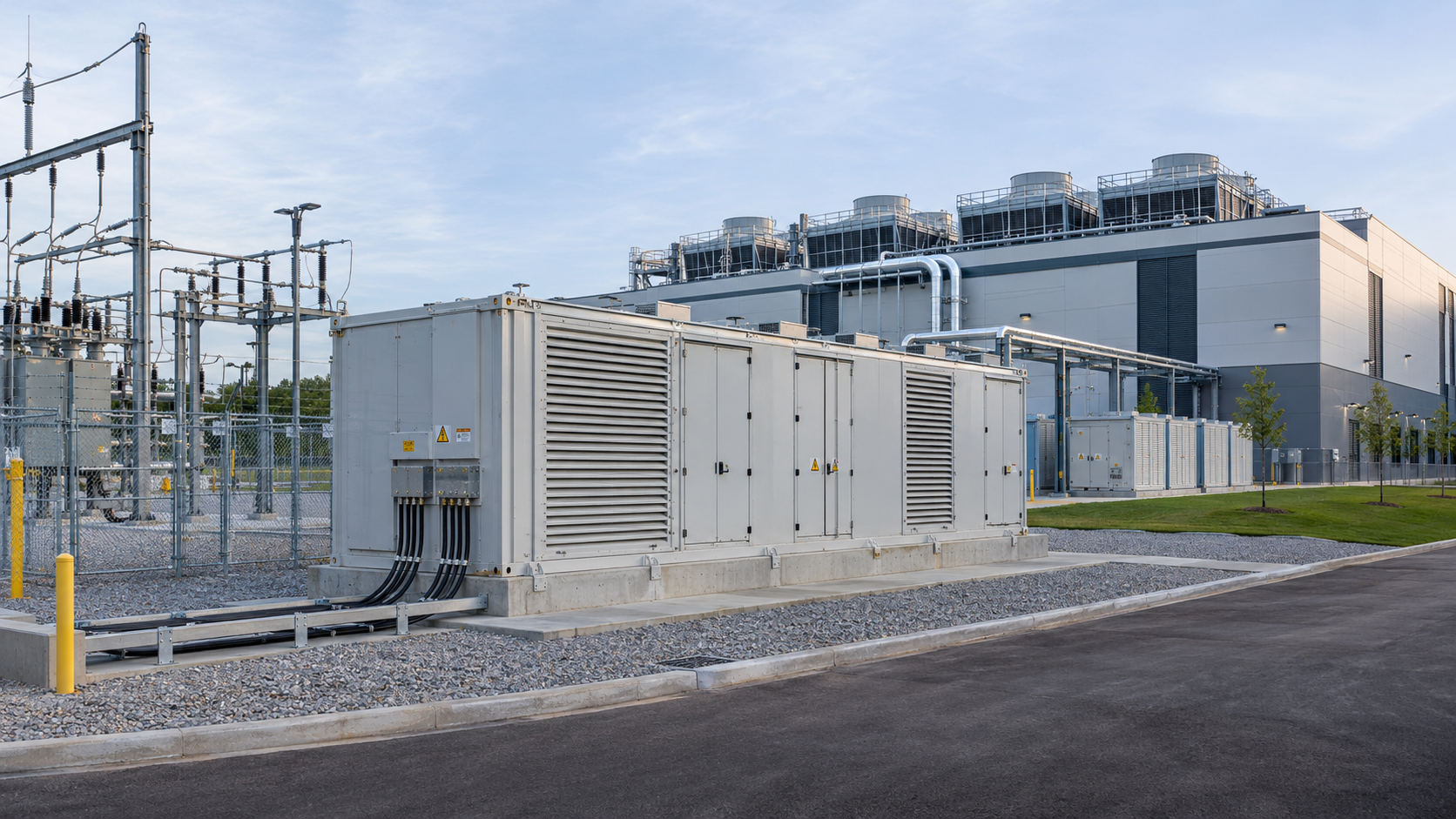
Vertiv has launched the 3 MVA PowerNexus MV UPS, moving UPS functionality from the indoor low-voltage side to the outdoor 34.5kV grid connection point. Designed for new and expanding AI data centres, the system integrates fault ride-through, AI load smoothing, power-quality control and one-to-four-hour battery backup. Following a proof-of-concept demonstration in Bologna, commercial shipments are expected to begin in mid-2027.

Envision Gen 8 Selected for 442 MWh Grid Forming BESS in Germany Taking Partnership Close to 600 MWh
Envision Energy and German storage developer ju:niz Energy are advancing the 442 MWh Smareg 13 project in Bavaria. The four-hour, grid-forming development is planned next to the operational Smareg 12 site, while public records currently show a 100 MW/401 MWh configuration and a March 2028 target date.

CATL Delivers First 8-Hour EnerQB Systems for Quinbrook's 24GWh Australian Pipeline
CATL and Quinbrook Infrastructure Partners have completed production and delivery of the first EnerQB long-duration energy storage systems. Designed for eight-hour discharge, the initial units will undergo a 12-month trial at Stanwell Power Station in Queensland, Australia. Quinbrook has identified a potential 3GW/24GWh project pipeline, although wider deployment will depend on trial results, financing, grid connections and subsequent procurement.

1.24GWh! Sungrow Supplies Europe's Largest Operational Energy Storage Project
BW ESS’s Hams Hall project in the UK has officially brought its first phase online, with 350MW/1.243GWh of capacity, making it the largest operational battery storage project in Europe. Sungrow supplied the BESS, with Energy-IO and other partners involved in project delivery. The project also secured a 10-year optimisation agreement with EDF, debt financing from international banks and equity investment from AIP, highlighting the full value chain behind Europe’s GWh-scale storage projects, from equipment supply and project delivery to commercial operations and financing.

BNEF's Q4 Energy Storage Tier 1 List Shrinks 26% to 50 Manufacturers
BloombergNEF has named 50 manufacturers to its Q4 2026 Tier 1 Energy Storage list. Based on publicly available company disclosures, Energy Planet has confirmed 19 of the manufacturers and compiled historical inclusion records for 12 of them. While a single appearance shows that a supplier met the criteria for that quarter, repeat inclusion offers a stronger indication of its ability to maintain a pipeline of qualifying projects. Tier 1 remains a measure of market adoption, however, rather than a product-quality ranking, corporate credit rating or substitute for project-level technical and financial due diligence.